Medicine’s Unspoken Crisis: The Resident Burnout
- Jibin Simon
- Dec 24, 2025
- 8 min read

"Suffering is not a curriculum"

THE ONES IN THE DARK SHADOWS
Medical residents, or people doing residency in medicine in general, are usually the backbone of any healthcare institute—especially in teaching hospitals or large-volume centres. They play a vital role in getting things done and keeping the system moving.
What patients usually see is the face of the institute: the famous, experienced professors, the highly acclaimed senior doctors. They are the visible representatives of the department. But beneath them, at the ground level, are people like medical residents. Highly qualified doctors who work day and night to ensure that patient care continues smoothly and that the hospital actually functions as it should.
At the ground level are medical residents. Highly qualified doctors, fresh from years of intense academic training, who suddenly find themselves at the frontline of patient care. They clerk patients late into the night, chase investigations, coordinate between departments, handle emergencies, update families, write notes, and ensure that plans made during rounds actually translate into action. When something needs to be done urgently, it is almost always a resident who does it.
Yet, despite how central they are to patient care, medical residents are frequently undervalued and under-validated. They operate in one of the most stressful phases of their lives, balancing learning, service, and survival, often with little recognition for the work they do. Still, they keep showing up, because without them, much of modern hospital care would simply grind to a halt.
DO WE CARE ENOUGH?
Do we care enough? That is a question we really need to ask ourselves. Do we genuinely care about medical residents? I honestly do not know. I am not sure we do.
From time immemorial, residents have been the backbone of every healthcare system. This is not a new observation; it is a long-standing reality. Yet, when we look at more recent data—especially studies systematically conducted in Western countries—the picture becomes uncomfortable.
A 2018 systematic review and meta-analysis of 26 studies using the Maslach Burnout Inventory reported burnout prevalence ranging anywhere from 27 to 75 percent(1). Most pooled estimates hovered around 35 to 45 percent, depending on the criteria used A 2024 multi‑center cross‑sectional study of 238 residents using Maslach Burnout Inventory found a burnout prevalence of 46.3%, with 57.1% high emotional exhaustion, 36.1% high depersonalization, and 52.4% low personal accomplishment (2). During the first wave of COVID‑19, a 2024 systematic review/meta‑analysis showed very high burnout prevalence in residents, though estimates varied widely by region and tool, often exceeding 40%(3).
When numbers like these are placed right in front of us, it is hard to deny that there is a serious problem. The question then shifts from whether there is an issue to something more uncomfortable: are we doing enough about it? Are we actually caring enough?
Despite all the discussions, data, and awareness, I often feel that we are not. And that, perhaps, is the most troubling part of all.
WHY WE OVERLOOK THE PROBLEM?
Another important part of this discussion is why we tend to overlook the problem in the first place.
Let me take a simple example. Long ago, when surgeries were first performed, there was no anaesthesia. Patients had to endure unbearable pain throughout the entire procedure. At that time, this suffering was seen as unavoidable. Perhaps doctors even believed that for something as beneficial as a surgery, pain was an innocent bystander, or a collateral that cannot be avoided; something sort of an unavoidable in front of something like a life-saving surgery. Enduring pain was thus normalised.
Today, that idea sounds unthinkable. Can we imagine performing surgery without anaesthesia? Absolutely not. The problem existed, and eventually, a solution was found. We learnt that pain could be eliminated without compromising results. In fact, outcomes became better.
I think we make a similar mistake when it comes to medical residents. We often overlook their stress and suffering because we assume it is necessary—that such pressure and hardship are essential to becoming a good doctor. I strongly feel this is the wrong way to look at it. The problem is real, and solutions may already be within our reach. We just are not doing enough to seriously look for them.
WE FORGET AS WE FINISH
Another important part of the problem lies with the people who actually have the power to bring about change. Most of them have already gone through similar, or sometimes even worse, experiences in their younger years. Over time, they tend to forget what it truly felt like—to be exhausted, overwhelmed, and constantly under pressure. What often remains is a simplified narrative: I went through this, and I turned out fine.
There is also an assumption that who they are today is largely because of the pain they endured back then. And maybe that belief itself becomes part of the problem. It feeds into that old, unspoken mindset: I suffered, so maybe you can too!
But is that really the right way to look at progress?
As generations move forward and time advances, human beings have always tried to improve systems—to reduce unnecessary hardship while maintaining, or even improving, quality. We do this everywhere else. We look for better tools, safer methods, and more humane ways of working. Medicine should be no different.
When those in positions of power forget what they endured, or worse, begin to believe that such suffering is essential, the same cycle continues. The next generation is pushed down the same path, change becomes painfully slow, and any reform that does happen is often superficial. Over time, this mindset can be deeply damaging—not just to individuals, but to generations of doctors who come after.
EMPATHY - LOUD BUT NOT CLEAR
Empathy is a strong word in medicine. We use it often. We teach our students and juniors to be empathetic towards patients and their suffering, and that is a beautiful and essential part of being a good doctor.
But empathy becomes strangely ironic when it is selective.
Telling someone to be empathetic to a patient’s pain, while being indifferent to the suffering of the people you are teaching or those working under you, does not sit right with me. Asking for compassion at the bedside but withholding it within the system creates a contradiction. I feel that is not a healthy way to go about our professional lives.
Empathy should not stop at the patient. It should extend to everyone who is suffering—and that includes residents and junior doctors who are working under us, often exhausted, stressed, and burnt out by a system that is clearly broken in many ways.
Maybe the first and simplest step is not policy changes or grand reforms, but acknowledgment. To recognise that people are struggling. To empathise with those who are overworked and emotionally drained, in the same way we instinctively empathise with a patient who is unwell. That, perhaps, is where real change can begin.
MORALITY AND NOBILITY - A MASK THAT NEEDS TO BE REMOVED
We often tell ourselves, and the people around us, that medicine is a noble profession. This idea is taught early, repeated often, and slowly pushed into us as something we are expected to live by. And yes, there is nobility in medicine.
But the problem is this: that language of nobility and moral high ground seems to appear only in very specific situations.
It becomes loud when doctors ask to be paid fairly for the work they do. It surfaces when someone wants to take a break, asks for leave, says they are tired, or admits they are burnt out. That is when the reminders come—that this is a noble profession, and therefore personal discomfort should not matter. That you, as an individual, are not the priority.
In the name of nobility, the work becomes sacred, the patient becomes sacred—but the person doing the work slowly disappears. The moral high ground is used not to inspire, but to silence. To suggest that wanting rest, dignity, or balance somehow dilutes professionalism.
That is where the idea becomes dangerous. Because nobility should never mean self-erasure. A profession can be meaningful and humane without demanding that the people within it constantly sacrifice themselves.
INDIAN PERSPECTIVE - WHY WE NEED BIGGER CHANGE
These situations are slowly changing in the West, and in many ways, the system itself is helping that change.
Take countries like the United States or the United Kingdom. Insurance is mandatory or widely prevalent, and the cost of medical care is high. Because of this, hospitals and doctors do not need massive inpatient numbers to remain financially viable. Profit is not purely volume-driven. As a result, workloads are relatively controlled, doctor–patient ratios are more evenly distributed, and care is not limited only to large urban centres. Doctors are paid reasonably well even in rural or peripheral areas, and the living conditions there are often better than what we imagine.
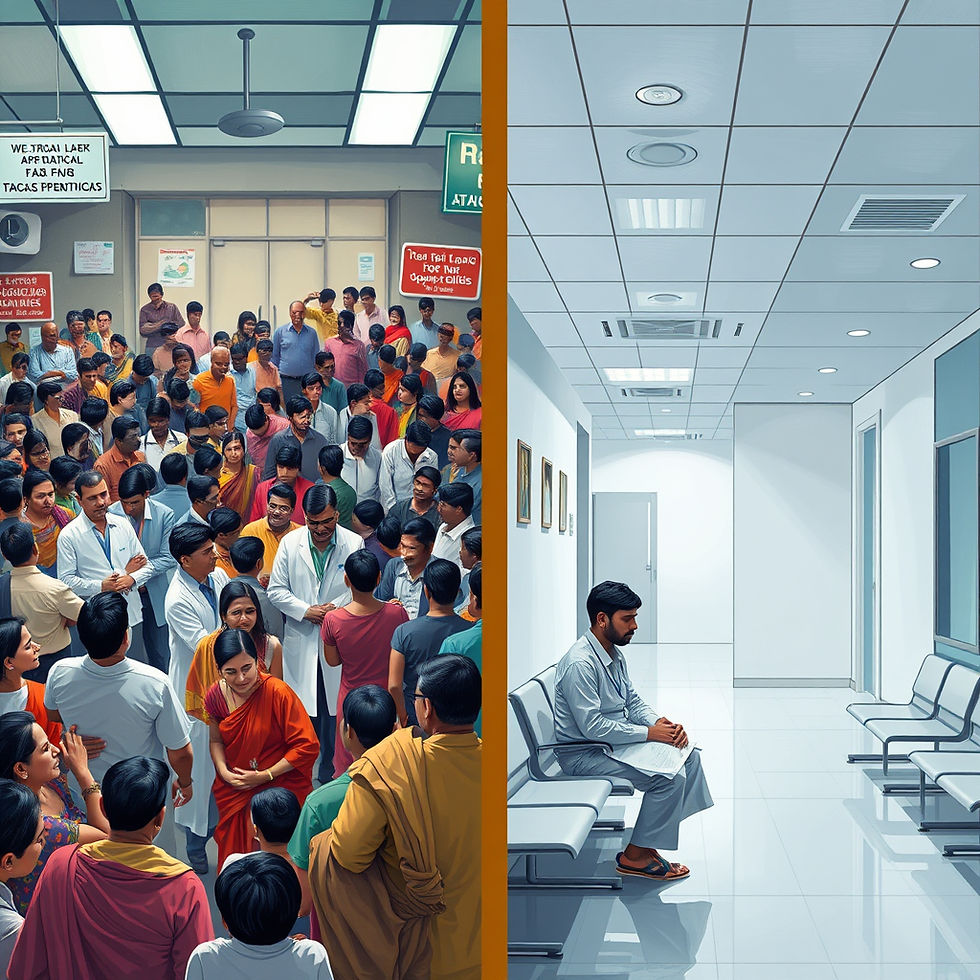
Now compare this with India. Most patients pay out of pocket. Insurance penetration is limited, and hospitals are forced to keep prices competitive to survive. Since pricing cannot rise too much, the system turns to volume to generate revenue. More patients become the answer to staying profitable.
When volume becomes the goal, fewer doctors are made to see more patients. The margin is created not by improving efficiency, but by increasing workload. Doctors are paid far less compared to what hospitals earn from the sheer number of patients they see. This imbalance leads to excessive workload, burnout, and compromised care—and it clearly points to a systemic fault rather than an individual one.
Over time, doctors themselves begin to accept this reality. Seeing large numbers of patients becomes normalised, even necessary, for survival within the system. And once that acceptance sets in, the cycle perpetuates itself.
As a society, we also play a role. In India, we often glorify overworked and exhausted professionals. We admire “hardworking” doctors who see hundreds of patients a day, without questioning the quality of care that is realistically possible under such conditions. Volume is praised; quality is quietly ignored.
If you look at the UK or much of Europe, the public healthcare system is structured very differently. Patients cannot directly access any specialist they want. Referrals are tightly regulated, and care is delivered in a stepwise manner. There is a strict division of labour, designed to protect both doctors and the system. While this may limit a patient’s freedom to choose a doctor—a freedom that exists widely in India—it also prevents unchecked overload and ensures sustainability.
Each system has its trade-offs. But when workload becomes overwhelming and burnout becomes the norm, it is hard to deny that something fundamental needs to change.
ACCEPTANCE - FIRST STEP TO ANY PROBLEM
There is no single-step solution to a problem this large and deeply rooted. As I mentioned earlier, the first and most important step is simply acknowledging that the current system and habits are unhealthy—and that we should not keep perpetuating them whenever we are in positions of control.
Once we accept that this is a real problem, and that it is not normal, we naturally begin to look for solutions. One solution alone may not work. Some attempts may fail. A process of trial and error is inevitable. But none of that can even begin unless there is a shared, universal acceptance that something is seriously wrong and needs to be addressed.
When acknowledgement happens, empathy follows. You begin to see the people working under you differently—not as tools to manage workload or keep large patient numbers satisfied, but as human beings under stress. You are less likely to judge them, scold them, or push them to overwork simply to maintain volume. Sacrificing one person’s health for another’s benefit is an unfair trade-off, no matter how noble the intention sounds.
Most of the issues I have spoken about do have potential solutions in front of us. The real challenge is not the absence of ideas, but the absence of intent. We need to make up our minds that this system needs to change.
I am not the one to suggest how these changes should be implemented. There are people far more intelligent and experienced who are capable of designing better systems—if the problem is clearly recognised. But unless we openly acknowledge that medical residents are burnt out, depressed, and overworked—and that this is neither normal nor acceptable for society or for future generations—meaningful change cannot begin.
A system meant to heal should not break its own. Suffering is not a curriculum!
BIBLIOGRAPHY
Rodrigues H, Cobucci R, Oliveira A, Cabral JV, Medeiros L, Gurgel K, et al. Burnout syndrome among medical residents: A systematic review and meta-analysis. PLOS ONE. 2018;13(11):1–17.
Resident physician burnout and association with working conditions, psychiatric determinants, and medical errors: A cross-sectional study | PLOS One [Internet]. [cited 2025 Dec 24]. Available from: https://journals.plos.org/plosone/article?id=10.1371%2Fjournal.pone.0312839
Navinés R, Olive V, Hidalgo-Mazzei D, Langohr K, Vieta E, Martin-Santos R. Burnout in residents during the first wave of the COVID-19 pandemic: a systematic review and meta-analysis. Front Psychiatry [Internet]. 2024 Jan 24 [cited 2025 Dec 24];14. Available from: https://www.frontiersin.org/journals/psychiatry/articles/10.3389/fpsyt.2023.1286101/full
Comments