Healthcare - Irony of the Indian Luxury
- Jibin Simon
- Dec 7, 2025
- 4 min read

What is the luxury?
So often, we find ourselves questioning—or even despising—the Indian healthcare system, usually by holding it up against Western models. Many people genuinely believe that our system is inferior. But that perception often comes from not recognising the kind of access and ease Indian patients actually enjoy. In fact, we probably have one of the most accessible public healthcare systems in the world, even if the quality varies widely. What people in India take for granted is considered a luxury in many Western countries.
For instance, long waiting periods and strict referral pathways are an entrenched reality in the West. You generally cannot just call up any hospital and book an appointment to meet a specialist. You need to go to see a general practitioner first; then that doctor will decide whether your case merits a referral. Only then can you take the next step—usually after many more weeks of waiting. Now, compare this to what happens in India. Any patient can walk into a top hospital in this country, pay the consultation fee, and meet a super-specialist that very day. No layered bureaucracy sits in judgment over whether you are “eligible” to see someone better qualified. Even in government hospitals, notwithstanding all their shortfalls, you can meet most types of specialists directly—and often without appointment.
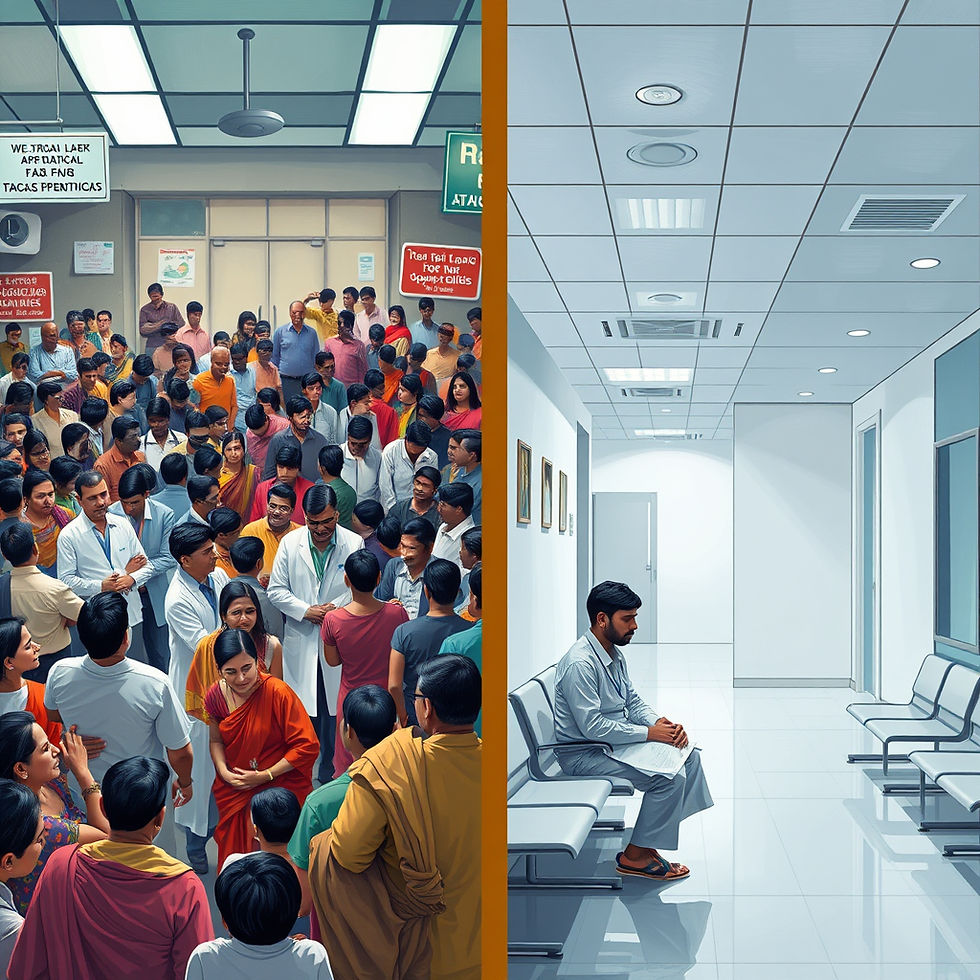
What's the irony?
Now, what does such a healthcare setup actually mean for the quality of life of both patients and doctors? When I said patients in India live in “luxury,” I was referring to the luxury of choice. You can go wherever you want, meet whoever you want, and get treated whenever you want. But does that translate into better healthcare than what the West offers? That is far from certain. The problem is rather simple: if you give people a choice, they will naturally try to choose what they think is “the best.” Most of the time, these choices are based on limited medical understanding. A patient with a routine headache—something that any competent general physician can manage—may insist on seeing a neurologist. Why? Because in his mind, going straight to the top guarantees better care.
But this behaviour begets a cascade of problems. By bypassing the basic levels of care, patients overload the very specialists who are supposed to deal with complex, high-priority cases. Rather than spending their time on the “cream” of their speciality—the cases that really need their expertise—super-specialists are forced to deal with simple, routine matters that should have been filtered out further up the chain. What does this lead to? A system where the most qualified doctors are drowning in volume. They are compelled to move quickly, settle cases fast, and keep the queue moving. Patients may feel like they are receiving “premium care” because they met a big-name consultant, but in reality, they are getting rushed, diluted attention—far from the quality they imagine.
This affects doctors just as much: without a structured referral network, specialists are continuously bombarded with cases that never require their level of expertise. And in a system such as ours, they cannot refuse patients. They are supposed to accommodate all, which of course takes away the time and mental bandwidth they should be dedicating to the challenging core of their speciality. So in the very freedom our system promises, often lies compromise—compromise on quality in patient care and in the lives of doctors trying to do justice to their field.
A Change that no one really wants
The most interesting part of this whole problem is that almost everyone within the medical fraternity recognises this. The doctors know this problem exists. The administrators know it does. Yet nothing changes. Why? Because the root of the problem in Indian healthcare has always been its business model—its relationship with money. In a corporate setup, many doctors work under targets. They are expected to see a certain number of patients, generate a certain amount of revenue, and keep the outpatient numbers high. So, when a large volume of cases walks in—whether they require that speciality or not—the system actually rewards it. A patient with a simple problem becomes just another number that helps meet the monthly goals. The irony is that this keeps everyone superficially satisfied. Patients feel good because they believe they have met a senior specialist and received “the best care.” Doctors, though drowning in volume, feel like they are performing well because their targets are being met. It feeds everyone’s short-term interests, and hence, the cycle goes on.
But in reality, this model is like a slow poison, which both sides consume willingly. It prevents proper triaging, dilutes the meaning of expertise, and gradually pushes specialists away from the real work they should be focused on. And when you zoom out, only one group truly benefits: the hospitals.
The system is built to maximise the revenue, not necessarily to optimise patient outcomes or doctor well-being. Everybody recognises the problem, yet nobody advocates for change. The structure is inextricably linked with incentives that perpetuate the system in its present form, even though it silently undermines the quality of care and quality of life of those involved.

Comments